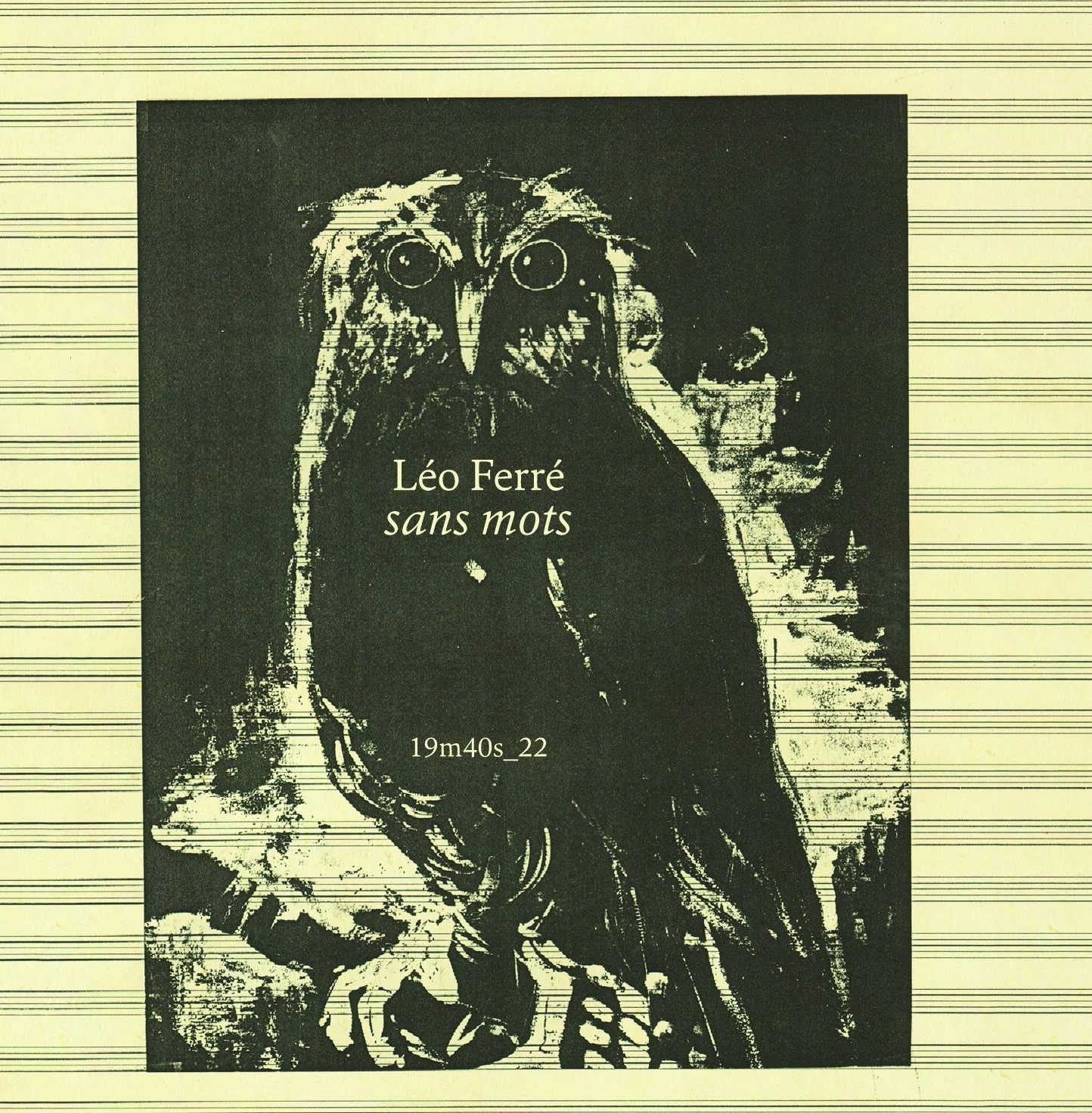
LEO FERRE SANS MOTS
Léo Ferré Sans Mots 19m40s_22

Ferré disegnato da Enrico
Il disco numero 22 della collana 19’40’’ è figlio di una scelta emotiva.
Prima di tutto per un legame spirituale con l’attitudine autarchica dell’uomo di cui stiamo per parlare (a noi di 19’40’’ l’autarchia e l’anarchia piacciono moltissimo…). E poi perché è la prima volta in assoluto che sentirete questa musica in questa veste.

I manoscritti di Léo Ferré
Stiamo parlando di una scelta di brani scritti e arrangiati dal grande Léo Ferré, in una versione “sans mots”, ovvero senza parole: a sua musica e il suo ingegno di compositore messo completamente a nudo nell’incanto della timbrica sinfonica, ridotta per l’occasione ad ensemble.
Gli Esecutori di Metallo su Carta diretti da Marcello Corti, eseguono questi dieci brani scritti in un arco di anni che vanno dal 1975 al 1992. L’excursus dell’album senza parole inizia, paradossalmente, con il brano “Des Mots” e conclude con “Words, words, words…” come a dire che le parole qui sono solo un pretesto per dire altro.
Come dice il figlio Mathieu Ferré, produttore assieme a noi in questa bellissima avventura “mio padre è stato soprattutto un compositore: la poesia, la sua parola e la sua interpretazione sono venute dopo. Se avesse potuto vivere esclusivamente della sua musica, è possibile che avrebbe composto di più e scritto molto meno.”
In questo disco vi sono anche due inediti compresi di testo e voce, composti nel 1992 che purtroppo Léo non riuscì ad incidere: “Liberté” e “Le Camelot”.
Liberté si avvale della ricostruzione della voce di Léo in AI ad opera di Francesco Fusaro, una scelta “forte” ma, a nostro avviso, musicologicamente interessante e rispettosa.
Le Camelot invece sembra un estratto della Thaïs di Massenet ed è per questo che abbiamo deciso di proporlo con l’ausilio della voce lirica del mezzo soprano Francesca Biliotti. Usando le parole di Mathieu “speriamo dal profondo del cuore che questa pubblicazione offra l’opportunità di scoprire la sua musica e che possa aprire la strada all’ascolto di queste opere ad un pubblico che ancora non le conosce.”
Tra tutti gli album prodotti sin qui da 19’40’’ questo è il disco più malinconico, sentimentale e struggente. Se “l’emozione” in questa musica fosse codificata col gesso di una formula matematica, la nostra lavagna sarebbe tutta un groviglio di segni bianchi.
Ci chiediamo se Léo, artista solitario e caparbio, capace di fronteggiare contro una tumultuosa enorme massa sinfonica avrebbe apprezzato questa veste “in miniatura” delle sue partiture.
Ma la risposta non possiamo far altro che lasciarla a voi.
The 22nd album in the 19’40’’ series uniquely explores Léo Ferré's music, titled "Sans Mots." It presents ten wordless tracks arranged by Ferré and performed by Metallo su Carta Conductors under Marcello Corti's direction. These pieces span from 1975 to 1992, including two unreleased songs, "Liberté" and "Le Camelot," the latter featuring mezzo-soprano Francesca Biliotti's voice.
Mathieu Ferré emphasizes his father's identity primarily as a composer, noting his passion for music preceding his poetry and interpretation. This album delves into Ferré's emotional depth through melancholic, poignant melodies. However, it remains uncertain whether Ferré, a resolute artist, would have embraced this "miniature" adaptation of his compositions. The project's core aim is to introduce audiences to Ferré's remarkable music and to provide an opportunity to appreciate his compositional genius beyond words. The use of AI for certain tracks and additional voices is deemed bold yet musically intriguing and respectful. Ultimately, how Ferré would have welcomed this new interpretation is open-ended, left to individual listeners' interpretation.
BCM#8: GEORGE WALKER
In August, Black Classical Music will be released, the twenty-first release by 19'40''. It includes works by Afro-descendant composers. In this series of articles, we tell the stories of the composers and their work.
GEORGE WALKER

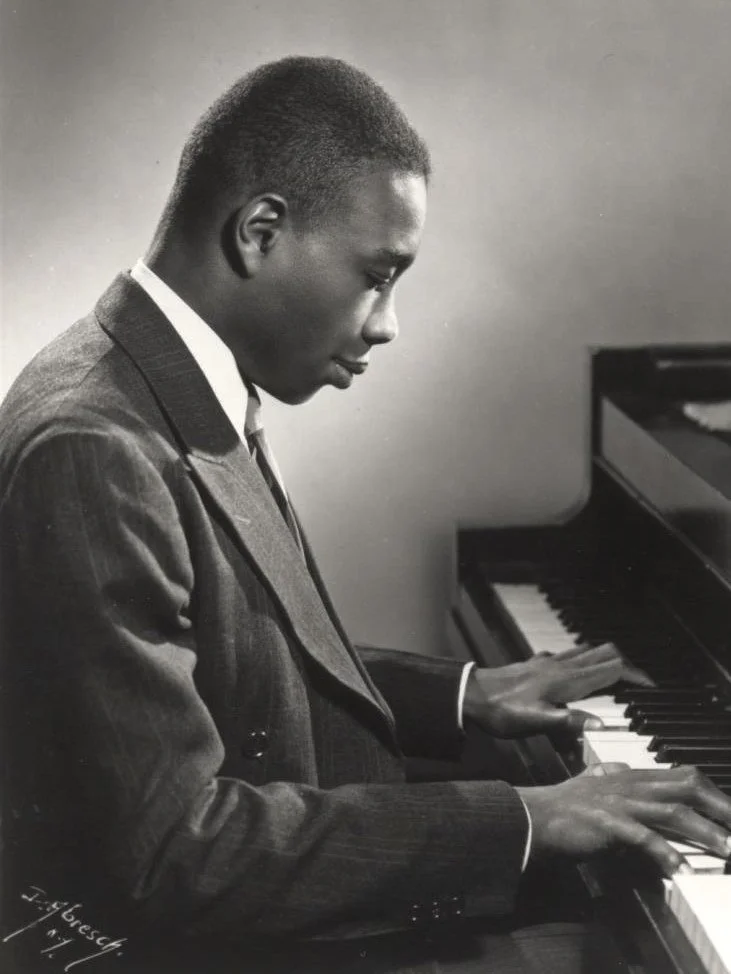
Di Unknown Photography Studio - Unknown, CC0, Collegamento
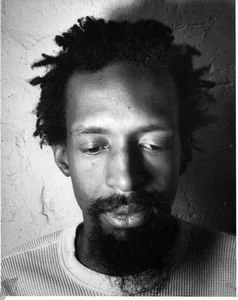
George Walker was a highly esteemed American composer who left an indelible mark on the classical music world. Born on June 27, 1922, in Washington, D.C., he achieved historical significance as the first African American composer to be honoured with the Pulitzer Prize for Music.
From an early age, Walker displayed exceptional talent as a pianist, which led to his admission to the prestigious Curtis Institute of Music in Philadelphia. Under the guidance of the legendary Beethoven interpreter Rudolf Serkin and the Italian composer Rosario Scalero, he honed his skills and unleashed his creative genius.
Walker’s compositional style was profoundly influenced by the likes of Johannes Brahms and Samuel Barber (who was taught by Scalero), resulting in a distinctive fusion of traditional forms with contemporary musical idioms. Notable works include the groundbreaking Lyric for Strings, the powerful Lilacs for voice and orchestra, and the last score he completed, Sinfonia No. 5 “Visions”.
Throughout his career, he received esteemed awards such as the Academy Award from the American Academy of Arts and Letters, the George Peabody Medal, and the George W. Chadwick Medal from the Boston Symphony.
Furthermore, George Walker made significant contributions as an educator, sharing his musical knowledge and passion with students at prestigious institutions such as Smith College, the Peabody Institute, and the University of Colorado. He passed away on August 23, 2018.
Bleu, for violin (Arr. for vibraphone)
George Walker's preference for the violin has a simple explanation: his son Gregory is a splendid violinist. In '58 and '79, father and son recorded together the two Sonatas for Violin and Piano. Bleu, dating back to 2012, was performed by Gregory himself at the Coolidge Auditorium in Washington DC. George Walker masterfully synthesises some of the predominant elements of the blues through highly sophisticated compositional gestures. Throughout the piece, lowered intervals of the third, fifth, and seventh are scattered. Amidst brief moments of lyricism intertwined with faster phrases, two fleeting nods to popular jazz melodies emerge. Sebastiano De Gennaro chooses to perform Bleu on the vibraphone, adding a softer glow to the cool brilliance of the metal, occasionally thawing the icy soundscape of the piece. This execution's detached colouring softens the composition’s harmonies, bringing them closer to a less academic sonic universe. Under this new light, Bleu becomes a work suitable for both grand showcases of contemporary classical music and an evening of solo vibraphone on the stage of Milan's Blue Note.
BCM#7: JULIUS EASTMAN
In August, Black Classical Music will be released, the twenty-first release by 19'40''. It includes works by Afro-descendant composers. In this series of articles, we tell the stories of the composers and their work.
JULIUS EASTMAN

Julius Eastman was an American composer and pianist renowned for his pioneering work in the realm of minimalist music. Born on 27th October 1940 in New York, Eastman’s life and career were marked by artistic innovation and an unwavering pursuit of unconventional musical expression.
Eastman’s musical style was characterised by what Alex Ross has described as “guerrilla minimalism.” He shook up traditional composition norms by incorporating elements of improvisation and experimentation into his works. In the 1970s, Eastman became closely associated with the influential Downtown New York music scene, collaborating with notable figures such as Meredith Monk. He even took on the uproarious role of George III in Peter Maxwell Davies’s Eight Songs for a Mad King, showcasing his versatility and captivating stage presence.
However, as an openly gay Black man in the predominantly white and heteronormative classical music world, Eastman faced an uphill battle. His career began to decline in the 1980s due to personal struggles, and he grappled with marginalization, financial difficulties, and homelessness, tragically resulting in the loss and destruction of a significant portion of his work.
Eastman’s life was cut short at the age of 49. He passed away on 28th May 1990, under circumstances that added to this remarkable musical talent’s tragic and untimely end.
Macle (Live version for five voices)
Alternative notations play an important role within the work of Esecutori di Metallo su Carta, both live and in the studio: Cardew's Treatise, Filidei's Toccata for Piano, and Della Marina's Fades/Constellations are some of the most visually intriguing pages tackled in recent years by our in-house ensemble. Julius Eastman's Macle fits perfectly within this departure from traditional notation. The score consists of only seven pages divided into rectangles and squares, which, when aligned, seem to recall an old Mickey Mouse comic: instead of ducks and mice, each panel is filled with lines, symbols, and texts. The ensemble consists of four voices: the performers must simultaneously read the panels and perform what is indicated within them. The performance is built by collectively deciding how to approach and interpret the graphic symbols, which are clear enough (there is only an autograph version for Macle), but not always unambiguous. The score indicates a duration of approximately 33 minutes; we present a version lasting only 11 minutes, performed live at Santeria during the ContempoRarities Festival on 5th December 2021. The performers, in this case, five members of Esecutori, were coordinated and guided by Francesco Fusaro, who also performs in it. Macle is simultaneously an exercise in style, avant-garde theatre, and a fascinating journey through new languages and sounds.
BCM#6 JOHN WESLEY WORK III
In August, Black Classical Music will be released, the twenty-first release by 19'40''. It includes works by Afro-descendant composers. In this series of articles, we tell the stories of the composers and their work.
JOHN WESLEY WORK III
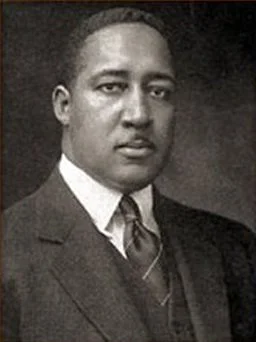
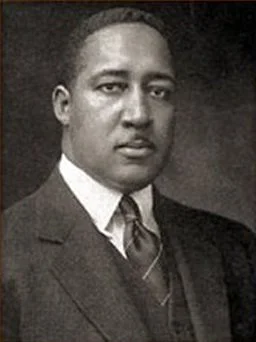
John Wesley Work III was a prominent African American composer, scholar, educator, and folklorist who made significant contributions to preserving and promoting African American music. Born on 15th September 1901 in Tullahoma, Tennessee, Work came from a distinguished musical family.
With a celebrated Fisk University Jubilee Singers member, John Wesley Work Jr., as his grandfather, and John Wesley Work II as his father, he inherited a treasured musical heritage firmly rooted in his family's distinguished lineage. Work's passion for music led him to become a versatile musician proficient in various instruments, including the violin, piano, and trombone.
Work's scholarly pursuits were equally remarkable. After completing his undergraduate studies at Fisk University, he pursued a master's degree in music from Northwestern University in 1927. He went on to earn a doctorate in musicology from the University of Chicago in 1941, becoming one of the first African Americans to achieve this distinction.
Work's compositions encompassed choral music, orchestral works, and solo pieces. His most notable composition, "Go Down, Moses," became an iconic spiritual arrangement, earning him widespread recognition.
Work was also an esteemed educator. He served as a faculty member at Fisk University for over forty years.
At A Certain Church & Ring Game
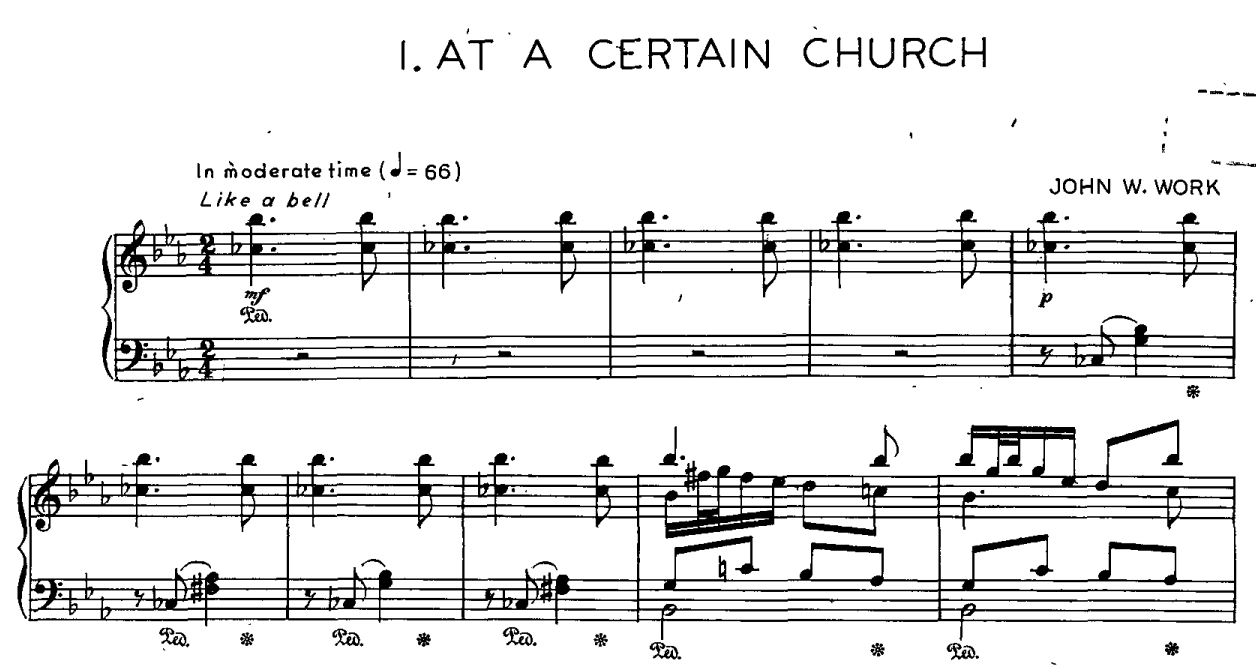
Out of the three movements comprising Scuppernong, "At A Certain Church" and "Ring Game" truly capture the essence of John Wesley Work III's microcosm. "Ring Game" is a concise composition that tips its hat to Béla Bartók's piano albums for small hands, an exceptional exemplar of ethnomusicology, harmonic exploration, rhythmic mastery, and pedagogy in the annals of human history. "Ring Game" is a simple and delicate solo piano piece, enriched with folk-inspired material and intriguing modal choices which evoke a profound sense of nostalgia. In "At A Certain Church," folk melodies make a comeback, intricately intertwined with one of the defining threads in Wesley Work III's oeuvre: choral music. The commencement of a prayerful moment is heralded by a recurring minor seventh interval. The non-religious activities transpiring outside the sacred confines, portrayed by a brief folk melody, are abruptly interrupted by the resonating call of the bell. As the congregation gathers within the hallowed space, they raise their voices in a harmonious chorus. Work III's evocative portrayal of religious devotion is subtly veiled with a touch of poignant affliction.
BCM#5: ROBERT NATHANIEL DETT
In August, Black Classical Music will be released, the twenty-first release by 19'40''. It includes works by Afro-descendant composers. In this series of articles, we tell the stories of the composers and their work.
ROBERT NATHANIEL DETT

Robert Nathaniel Dett was a highly accomplished African-American composer, pianist, and choral conductor. Hailing from Drummondville, Ontario, Canada, Dett exhibited prodigious musical talent from a tender age. He honed his musical skills at the prestigious Oberlin Conservatory of Music in Ohio, graduating with honours in 1908, becoming the first black individual to receive a music composition degree from the institution.
Dett held esteemed professorships at several educational establishments, including the Hampton Institute and Bennett College. At the core of his teaching philosophy was the belief in integrating African-American musical traditions into the academic curriculum, nurturing cultural pride and identity among his students.
Beyond his compositional achievements, Dett commanded great demand as a sought-after pianist and conductor. His captivating piano performances and masterful leadership of choral ensembles during extensive tours left audiences spellbound.
Throughout his illustrious career, Dett garnered numerous accolades for his remarkable contributions to the music world. His compositions, such as the acclaimed "The Chariot Jubilee" and "Listen to the Lambs," resonated deeply with audiences and critics alike. Dett's innovative musical style and his unwavering commitment to preserving African-American musical heritage firmly established him as a trailblazing figure in the annals of American music history.
Desert Interlude & Barcarolle of Tears (Arr. for vibraphone and piano)

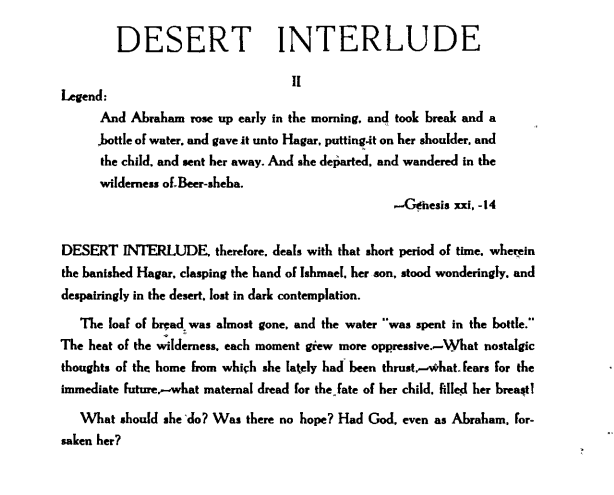
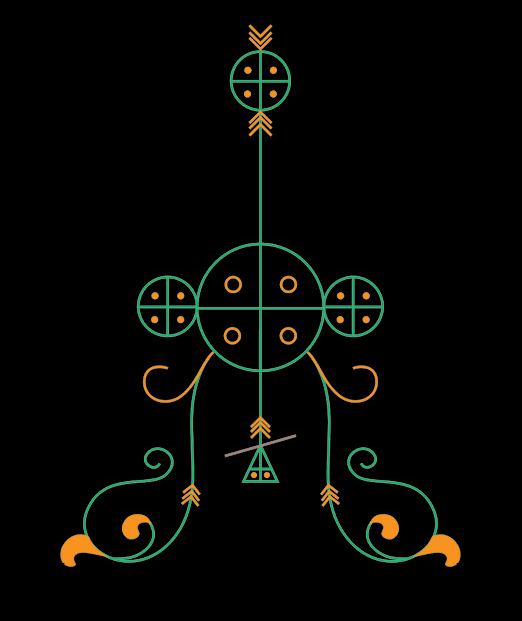
Eight Bible Vignettes is a collection of short solo piano compositions with a religious theme: each number's title page bears a precise biblical reference. The first three vignettes recount and depict episodes from the Old Testament. In "Desert Interlude" Robert Nathaniel Dett captures a very specific moment told in Genesis. Sarah, wife of Abraham, decided to give her slave Hagar to her husband with the intention of adopting her child. However, when the child is born, Sarah begins to resent Hagar's presence. Abraham is forced to cast out Hagar, leaving her and their son Ishmael in the desert. Desperate, Hagar becomes lost in the wilderness of Beersheba. As provisions run out, she finds herself lost in a moment of contemplation, reminiscing with nostalgia about the home from which she was banished and shedding tears of maternal love for her son's uncertain future. These are the evocative impressions that Dett captures on paper in writing "Desert Interlude." On the other hand, "Barcarolle of Tears" is a piece without direct references to biblical events, serving as a separator between the compositions related to the Old Testament and those that recount stories from the New Testament.
BCM#4: WILLIAM GRANT STILL
In August, Black Classical Music will be released, the twenty-first release by 19'40''. It includes works by Afro-descendant composers. In this series of articles, we tell the stories of the composers and their work.
WILLIAM GRANT STILL

William Grant Still was a prominent African-American composer and conductor who left an indelible mark on classical music.
Still’s compositions, spanning symphonies, operas, chamber music, and choral works, were characterised by a fusion of Western classical traditions and African-American musical elements. This unique blend showcased his rich cultural heritage, incorporating spirituals, jazz, and folk tunes.
In 1931, Still made history as the first African-American composer to have a symphony performed by a major American orchestra. His Symphony No. 1, “Afro-American Symphony,” premiered with the Rochester Philharmonic Orchestra, captivating audiences by incorporating blues themes and rhythms.
Beyond his musical achievements, Still made significant strides in breaking racial barriers. In 1936, he conducted the Los Angeles Philharmonic Orchestra, becoming the first African American to lead a major American orchestra. He also worked as the first African-American composer at 20th Century Fox in the 1940s, contributing to the film industry.
William Grant Still actively advocated for the recognition of African-American composers, making invaluable contributions to their inclusion in the classical music canon. His compositions often reflected the struggles and aspirations of African-Americans, serving as a catalyst for social change.
Summerland for piano (Arr. for alto sax and piano)
Summerland is the second of the Three Visions composed by William Grant Still for solo piano. It is also the only one that exists in a different form, as the composer turned it into a version for solo violin and small orchestra. Three Visions was composed for Verna Arvey, Grant Still's wife, who first performed this work in 1936. The composition is divided into three parts: the same melody introduces and concludes the entire movement, encompassing a central section where melody and counterpoint captivate the listener with its intensity and beauty. Catherine Parson Smith, an American writer who has followed Grant Still's work, states that "The harmonies in these Visions are strange," but we do not share the same opinion. Grant Still depicts the vision of paradise using harmonies that are extremely soft, deep, and rich, drawing from a blues and jazz-inspired sonic universe while also bearing the marks of his academic training. The melodic character of Summerland becomes even more apparent through the instrumentation chosen by Enrico Gabrielli.
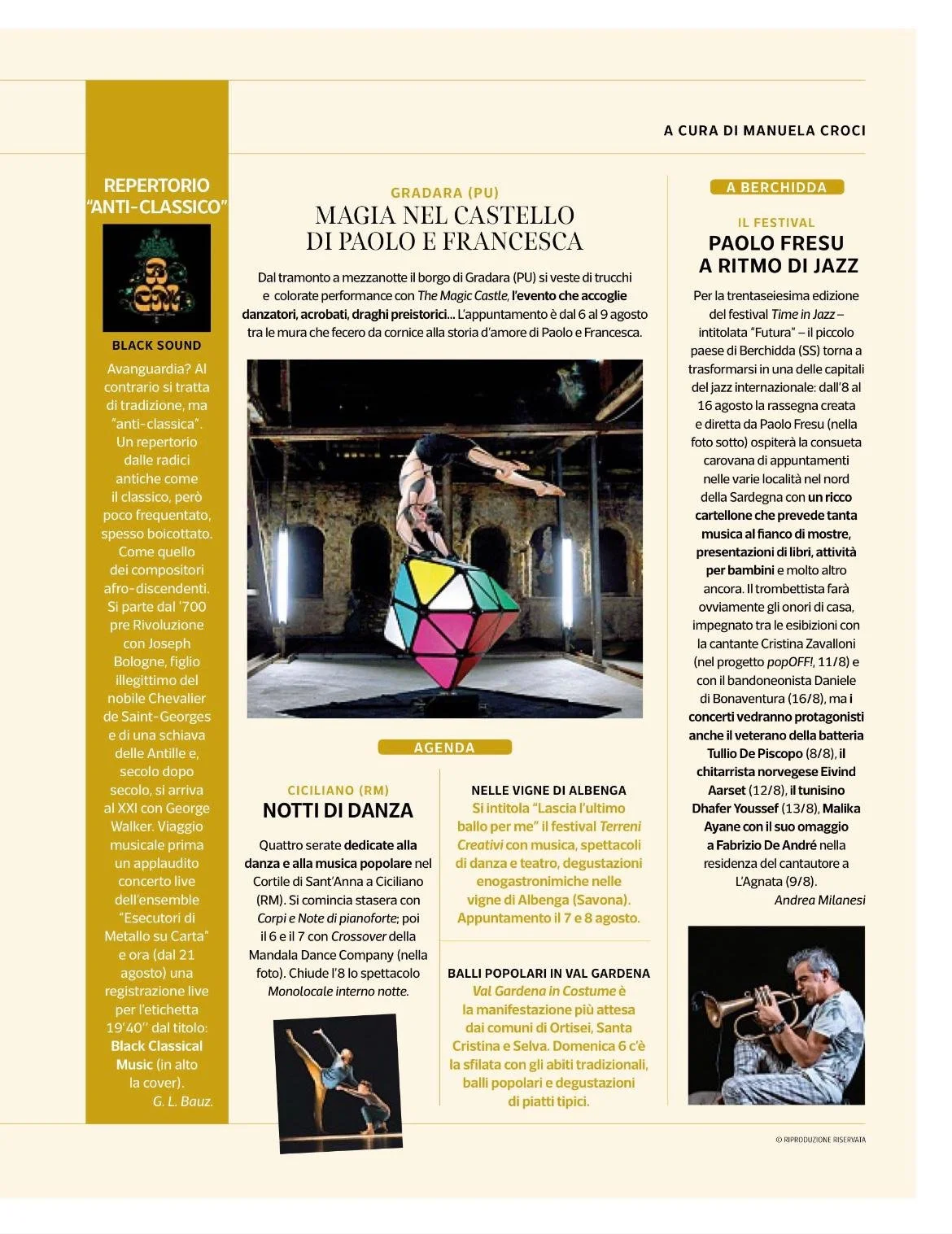
Black Classical Music on Sette by Il Corriere della Sera
Black Classical Music is featured in Sette by Il Corriere della Sera. Thanks to Gian Luca Bauzano.

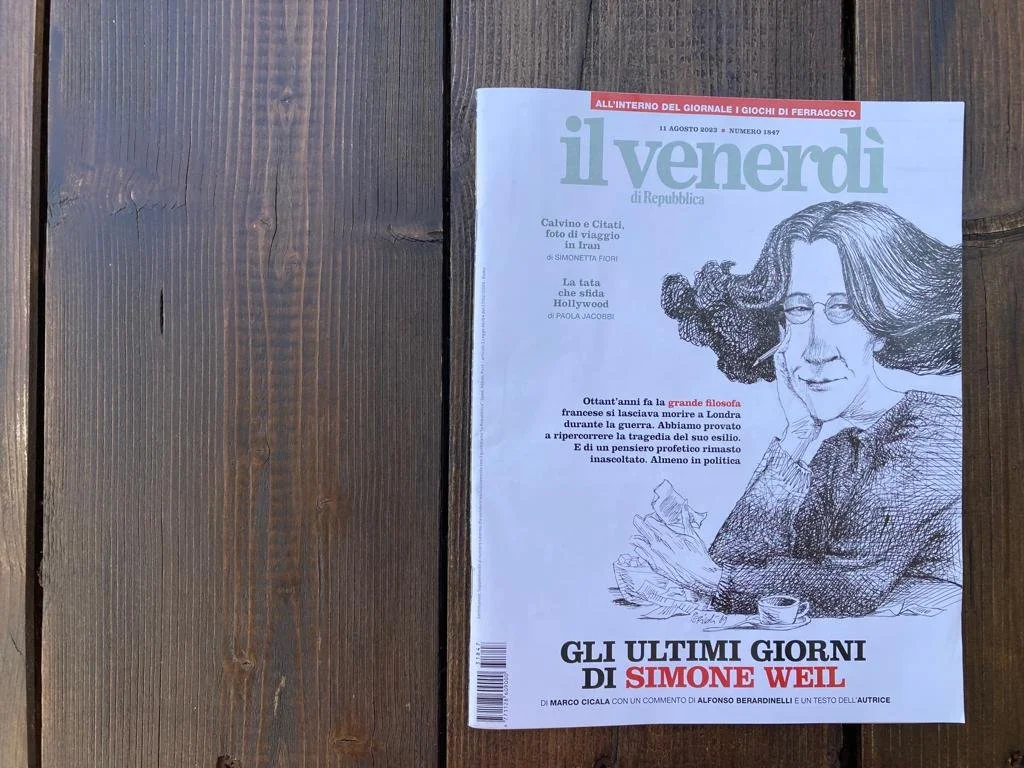
Black Classical Music on il venerdì di Repubblica
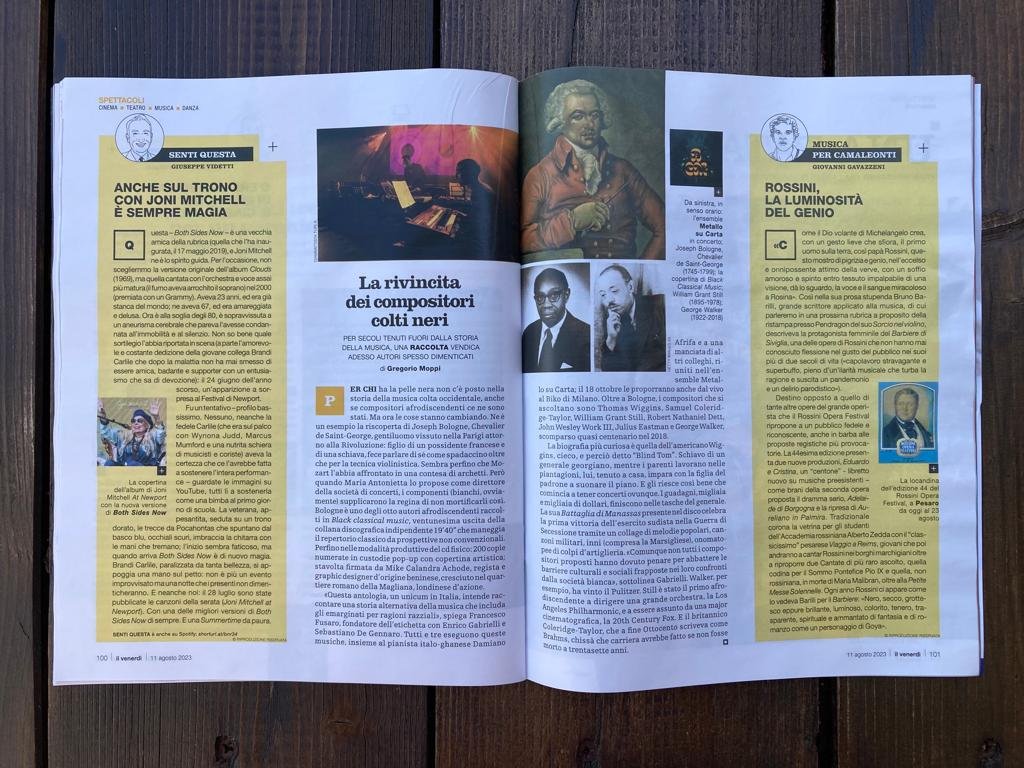
Black Classical Music is on il venerdì di Repubblica. Thanks to Gregorio Moppi.

BCM#3: SAMUEL COLERIDGE-TAYLER
In August, Black Classical Music will be released, the twenty-first release by 19'40''. It includes works by Afro-descendant composers. In this series of articles, we tell the stories of the composers and their work.
SAMUEL COLERIDGE-TAYLOR

Born in London in 1875 to a Sierra Leonean father and an English mother, Coleridge-Taylor's mixed heritage significantly shaped his musical perspective and personal identity. Raised by his mother and her extended family, he displayed exceptional musical talent from a young age.
Recognising his potential, his family supported his musical education, and he began studying at the Royal College of Music. There, he honed his skills as a violinist, but his compositional abilities truly set him apart. Coleridge-Taylor’s music drew inspiration from various sources, including African American spirituals, British folk melodies, and classical European traditions.
In 1904, Coleridge-Taylor embarked on a tour of the United States. His visit to America solidified his reputation as an internationally recognised composer and strengthened his connections with African American musicians and activists. Outside of his compositions, Coleridge-Taylor actively participated in the Pan-African movement, advocating for the rights and representation of black people. He embraced his African heritage and sought to elevate the status of black musicians and artists.
Tragically, his life was cut short when he succumbed to pneumonia in 1912 at 37. His legacy endures as organisations like the Black Cultural Archives in London strive to preserve his heritage and promote awareness of his significant role in shaping black cultural history.
Clarinet Quintet in F sharp minor, Op. 10
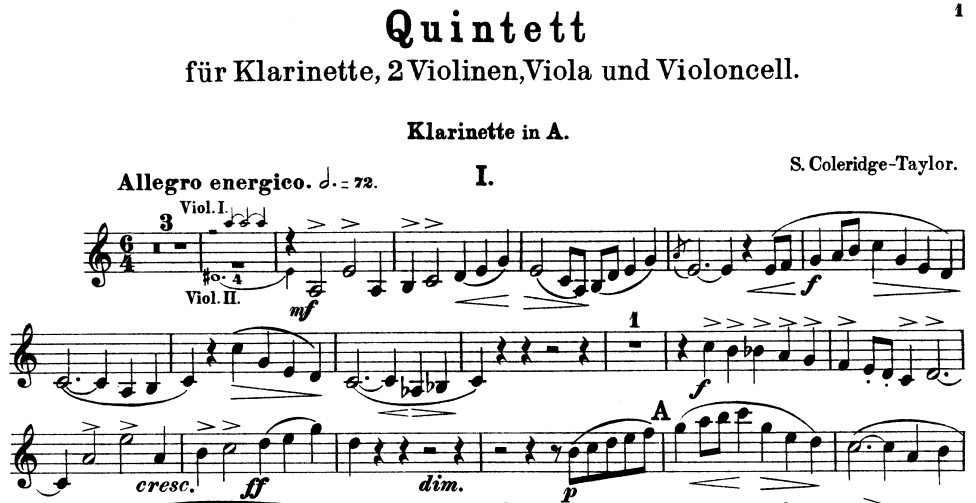
Clarinet, two violins, viola, and cello: Mozart had thought of inaugurating this unusual formation back in 1789. Over a hundred years later, starting in 1891, composers began systematically tackling the clarinet quintet: the turning point being Johannes Brahms' Op. 115. A few years later, in 1895, Samuel Coleridge-Taylor composed one of his early works: the Quintet for Clarinet and Strings in F-sharp minor, Op. 10, is of an almost staggering beauty. Coleridge-Taylor revealed himself to be one of the most promising composers of his generation. Unfortunately, the young musician was destined to die at the young age of 37, leaving behind a significant number of works, over eighty in total. Coleridge-Taylor's writing is highly mature and perfectly embedded within the European Romantic aesthetic in terms of form, harmony, and thematic material. The three movements presented here were recorded in Milan at the ContempoRarities Festival. The fourth movement, which was not performed, is omitted from the recording.
BCM#2: THOMAS 'BLIND TOM' WIGGINS
In August, Black Classical Music will be released, the twenty-first release by 19'40''. It includes works by Afro-descendant composers. In this series of articles, we tell the stories of the composers and their work.
THOMAS ‘BLIND TOM’ WIGGINS

Thomas Wiggins, also known as Blind Tom, was a remarkable 19th-century pianist and composer. Born in 1849, he was blind from birth and enslaved in Georgia. Despite no formal music education, he had a prodigious memory and could effortlessly play tunes he had just heard.
His extraordinary piano skills and versatile musical style garnered him fame as he toured extensively throughout the United States and Europe. Despite facing racism and discrimination, Wiggins captivated audiences incorporating classical, folk, and original compositions in his performances. Some of his original work was transcribed by a series of tutors who joined him on tour.
Though his annual salary as a touring musician was estimated at $100,000 at his peak, Wiggins was unable to fully benefit from his earnings due to his status as an enslaved individual. After emancipation, he continued to be in a dependent position, essentially serving as an indentured servant to Bethune, who eventually became Wiggins’ legal guardian.
He suspended his performing career for nearly two decades, from 1881 to 1904. During this period, he resided in Hoboken, New Jersey, under the care of his new guardian, Eliza Bethune, General Bethune’s son John’s widow.
He passed away on 13th June 1908 at 59.
The Battle of Manassas for piano (Arr. by S. De Gennaro for percussion and double bass)
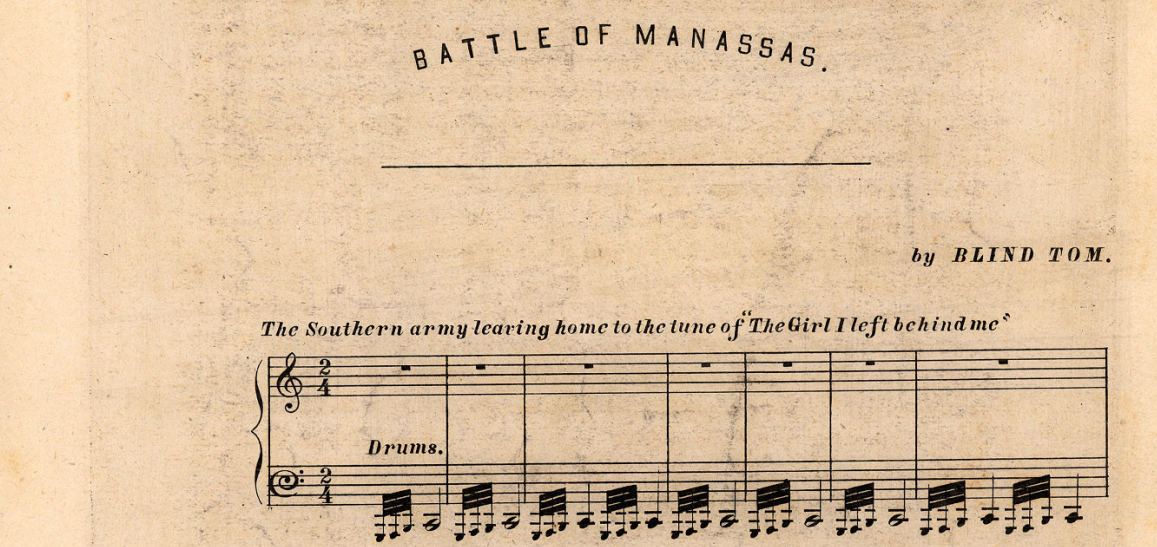
Assignment: Describe The Battle of Manassas by Thomas "Blind Tom" Wiggins in less than 1000 characters. Development: A 14-year-old African American slave, blind from birth, possesses the remarkable ability to reproduce entire musical compositions on the piano after a single listen. He channels this talent into composing a symphonic poem that recounts the significant first battle of the American Civil War. Astonishingly, Wiggins’ composition predates by several decades the innovative techniques embraced by early 20th-century composers. His pioneering use of Tonale Clusters, which would later be associated with ragtime and adopted by classical musicians such as Charles Ives and Béla Bartók, defies the conventions of his time. With a clever blend of popular melodies like "The Girl I Left Behind" and "Yankee Doodle," Wiggins injects a whimsical touch of programmatic music. Sebastiano De Gennaro, accompanied by Simone Beneventi, pushes the boundaries further by incorporating surprising sounds and blends. Meanwhile, Francesco Fusaro's voice, in harmony with Roberto Benatti's double bass, shatters the fourth wall, tearing the captions inserted by the composer from the silence of the printed page.